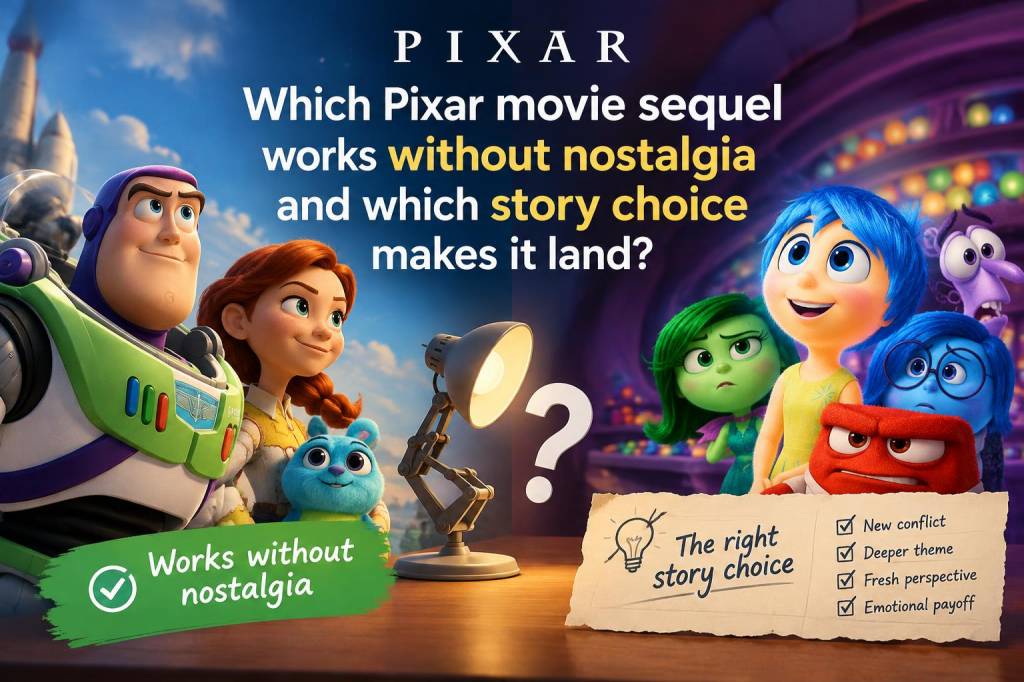
I keep coming back to one uncomfortable truth about animated sequels: nostalgia can carry a movie only so far. If a sequel survives because I remember loving the original, that is not enough. I want a film that stands on its own, with a fresh emotional engine, a real point of view, and a story choice that feels necessary rather than recycled. That is why one Pixar sequel has stayed with me more than most: Inside Out 2.
I did not walk into it expecting to be surprised. A sequel to a beloved film about emotions feels like a setup for easy repetition. You bring back familiar faces, raise the stakes a little, add a few new feelings, and lean on audience affection for the first movie. Yet I found myself responding to Inside Out 2 for reasons that had very little to do with remembering the original fondly. It works because it understands what a sequel should do: not just revisit a world, but push it into a new stage of life.
That is the real trick. The movie does not ask me to relive the emotional arc of the first film. It asks me to recognize a new reality. Riley is older, and the emotional landscape changes with her. That simple shift gives the sequel room to breathe. I am not watching a retread of childhood confusion. I am watching the messy, uncomfortable arrival of adolescence, and that makes everything feel newly alive.
A sequel earns attention by changing the problem
So many sequels fail because they mistake familiarity for value. They bring back the same jokes, the same emotional beats, and the same structure, then hope that affection alone will do the rest. Pixar usually avoids that trap when it is at its sharpest, and Inside Out 2 is a strong example of that discipline. The movie does not simply ask, “What if we made another adventure in the mind?” It asks, “What happens when the mind itself becomes more complicated?”
That is why I think this sequel works without nostalgia holding it up. I do not need to be sentimental about the first film to understand what is happening here. The story is built around a universal experience: growing up and realizing that the version of yourself that used to feel complete no longer covers everything. That is a genuinely good sequel idea because it is not based on memory alone. It is based on change.
The emotional math feels different too. The first movie was about learning that sadness belongs in the system. The sequel is about learning that not every feeling can stay simple or pure. Anxiety arrives not as a villain, but as a force that believes it is protecting Riley. That choice matters a lot to me because it gives the movie tension without flattening the new emotion into a cartoon threat.
The story choice that makes it land is making anxiety understandable
If I had to name the single story decision that makes Inside Out 2 land, it is this: the film refuses to make anxiety a joke or a monster. It lets anxiety be messy, urgent, persuasive, and even sympathetic. That is a brave choice, because it could have been easy to turn the character into a simple chaos machine. Instead, the movie treats anxiety as a real response to pressure, identity, and the fear of losing control.
That decision gives the whole film more depth than a nostalgia-driven sequel usually gets. I am not just waiting for old characters to pop up and remind me of a movie I already liked. I am watching a new emotional conflict unfold in a way that feels truthful. Anxiety is not there to replace Joy. It is there to challenge Joy’s assumptions about what helps Riley survive a more demanding world.
That tension is what kept me invested. The movie’s most effective moments do not come from callbacks, even when they are fun. They come from watching Riley negotiate conflicting needs at the same time: wanting to fit in, wanting to stay true to herself, wanting to belong, wanting to perform well, wanting to avoid embarrassment, wanting to remain “good.” That is where the film feels strongest, because it understands that adolescence is not a clean emotional upgrade. It is a pileup of competing instincts.
And yes, nostalgia is still present. Pixar knows exactly how to use familiar emotional architecture, and a few returning elements serve as a reassuring bridge from one film to the next. But they are not the engine. The engine is the story’s willingness to acknowledge that growing up means your inner world becomes harder to manage, not easier. That is where I think the movie earns its place.
What I notice in Pixar sequels that truly work
When I think about Pixar sequels that feel worthwhile, I notice a pattern. They do not merely extend a brand. They alter the emotional question. That is why certain follow-ups stay with me long after the credits, while others fade as soon as I stop comparing them to what came before.
- They create a new emotional pressure point, instead of repeating an old one.
- They let familiar characters evolve, rather than preserving them like museum pieces.
- They add a new theme that deepens the world instead of decorating it.
- They trust the audience to care about change, not just recognition.
- They make the sequel feel necessary, not convenient.
Inside Out 2 checks those boxes more often than not. It does not feel like a sequel made because a studio wanted another hit. It feels like a sequel made because Riley’s life genuinely required another chapter. That distinction matters to me more than any amount of fan service.
Why nostalgia alone is not enough for me
I have a soft spot for nostalgia when it is used well. I like a returning melody, a visual echo, a character who feels like an old friend. But nostalgia becomes a problem when it replaces dramatic necessity. If I already know exactly what a sequel is trying to make me feel, and it leans too heavily on that feeling, I start to disengage.
Pixar usually avoids that by grounding its sequels in emotional transition. That is why I am more interested in a sequel’s perspective than in its references. A good sequel should make me ask new questions. What does this character want now? What has changed in their world? What emotional territory was not available before?
In Inside Out 2, the answer is immediate. Riley is no longer just a child learning the rules of her internal life. She is a teenager trying to manage self-image, belonging, and uncertainty all at once. That shift gives the movie a very different texture. It feels more crowded, more unstable, and more truthful. I think that is exactly why it works even if I strip away any affection I already had for the first film.
What I think carries the movie emotionally
I keep noticing that the most effective Pixar sequels tend to understand emotional escalation. Not bigger explosions. Not louder jokes. Emotional escalation. The feeling must become more complicated, not merely more intense. That is where Inside Out 2 succeeds for me. It does not just raise the stakes around Riley’s choices. It deepens the consequences of every feeling she has.
The story choice to center anxiety also gives the movie a stronger sense of interior conflict. Anxiety wants control. Joy wants stability. Sadness wants honesty. Each force has a reason to exist, and none of them can fully solve Riley’s problem on its own. That makes the film richer than a simple victory story. I am not rooting for one emotion to defeat another. I am hoping Riley can integrate what is happening inside her without losing herself in the process.
That is a much more interesting ending point for a Pixar sequel than simple comfort. Comfort is easy. Integration is harder. The movie lands because it understands that a young person does not grow by erasing difficult feelings. She grows by learning how to live with them.
A quick comparison of what matters in Pixar sequels
| Element | Weak sequel | Strong sequel |
|---|---|---|
| Emotional idea | Reuses what already worked | Introduces a new life stage or conflict |
| Nostalgia | Main selling point | Supportive layer, not the core |
| Character growth | Minimal or cosmetic | Clear and unavoidable |
| Conflict | Familiar and shallow | Personal, specific, and emotionally current |
| Aftereffect | Short-lived enjoyment | Lingering emotional resonance |
That table is basically my internal checklist when I watch any Pixar follow-up. If a sequel passes those tests, I stay interested. If it relies on memory more than movement, I check out.
Why this one still feels relevant after viewing
What I admire most is that Inside Out 2 does not treat adolescence as a punchline. It treats it as a major emotional redesign. That makes the film feel more relevant than a simple continuation of a past success. I am not just watching familiar characters in a familiar place. I am watching a person become more complicated, and I think that is where animated storytelling can be at its strongest.
I also appreciate that the film respects the audience’s intelligence. It does not over-explain every feeling as if it needs to handhold me through the emotional mechanics. It trusts me to recognize what is happening, to understand why it hurts, and to see why the characters behave the way they do. That trust makes the movie feel more mature than a lot of franchise sequels, animated or otherwise.
When I think about which Pixar sequel works without nostalgia, I come back to this one because it feels grounded in a life change rather than a brand memory. And when I think about the story choice that makes it land, I come back to anxiety: not as a monster, but as a believable, flawed, and deeply human force that reshapes the whole movie from within.
That is what stays with me after a sequel earns my attention. Not just that it returned. That it returned with a reason.