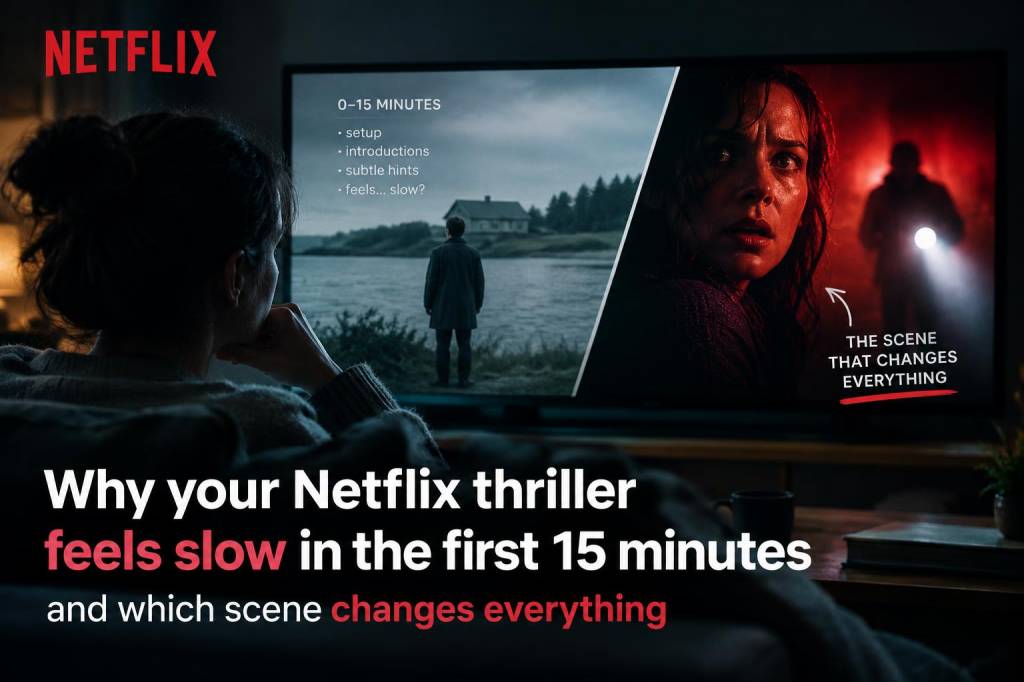
I have lost count of the number of times I have pressed play on a Netflix thriller, watched the opening stretch crawl by, and thought, Is this going anywhere? That feeling is more common than people admit. A lot of thrillers are designed to feel slightly off balance at first, and that first fifteen minutes can seem slow because the story is doing invisible work before it starts firing on all cylinders.
When a thriller feels sluggish early on, I usually do not assume it is bad right away. I assume it is setting a trap. The pace may feel restrained because the filmmaker is trying to make me settle into a normal rhythm before breaking it. A good thriller often wants me to relax just enough to miss the warning signs. That means quiet scenes, awkward pauses, domestic details, or what looks like ordinary small talk can actually be doing a lot of heavy lifting.
What makes this frustrating is that streaming culture has trained us to expect an immediate hook. We live in a world of autoplay previews, short-form clips, and constant distraction. So when a movie spends ten or fifteen minutes on atmosphere instead of action, it can feel like it is wasting time. But in thriller storytelling, delay is often a weapon. The slower the setup, the more violent the payoff can feel when it lands.
Why early pacing feels slower than you expect
One reason is simple: thrillers have to establish stakes, tone, and perspective before they can unsettle us. If I do not know who is vulnerable, what is at risk, or whose version of events I should trust, every later twist will land flat. So those opening minutes often spend time building the emotional map of the story. That can feel like hesitation, but it is usually preparation.
Another reason is that Netflix thrillers often need to compete in a crowded browsing environment, so they lean into strong premises. A sharp premise can create a false expectation of immediate chaos. If a show is marketed around a disappearance, a secret, or a murder, I may expect instant danger. Instead, I get characters entering a room, checking a message, looking out a window, or holding a conversation that seems too calm. That contrast can make the beginning feel slower than it really is.
I also think editing has changed our patience. A modern audience is used to relentless momentum, so any scene that lingers longer than expected can feel stretched. But in a thriller, stillness matters. Silence matters. A glance across a dinner table can matter more than a car chase if it tells me someone is lying.
What those opening minutes are doing behind the scenes
If I pay attention, I can usually see several jobs being handled at once in that early stretch. First, I am being taught the rules of the world. Is this story grounded and realistic, or stylized and heightened? Second, I am being shown the emotional weak points of the characters. Who is lonely, resentful, guilty, desperate, or secretly angry? Third, I am being placed inside a point of view. Once I understand where the story wants me to stand, later surprises hit harder.
That is why a thriller may seem calm at first and then suddenly become addictive. The early scenes are not filler if they are loading future meaning into small details. A locked door, a half-finished phone call, a missing object, a strange line of dialogue, a family tension that seems minor at first: all of it can be ammunition.
In my experience, the best thrillers trust viewers to do some of the work. They do not shout every clue. They let ordinary objects become suspicious. They let a simple pause become ominous. That is also why rewatching one can be so satisfying. What felt slow the first time often feels carefully engineered the second time.
The scene that usually changes everything
Almost every thriller has a turning point where it stops feeling like setup and starts feeling like a threat. For me, that scene is usually not the biggest explosion or the loudest reveal. It is the moment when someone lies in a way that matters, or when a character realizes they are not safe, or when a detail from earlier suddenly redefines everything.
In many Netflix thrillers, the scene that changes everything is one of these:
- A phone call that should have been simple but turns suspicious.
- A missing person sighting that contradicts what we were told.
- A private confrontation where one character drops the polite mask.
- An object returning from earlier in the story in a way that feels impossible.
- A perspective shift that reveals the opening scenes were misleading us.
That is when I usually feel the pace snap into place. The story stops arranging pieces and starts moving them. Suddenly every earlier quiet moment feels charged. A side character becomes important. A harmless conversation becomes evidence. The thriller wakes up because it has finally crossed from uncertainty into consequence.
If I want a useful mental marker while watching, I watch for the moment a character stops reacting and starts deciding. Early scenes often show people absorbing information. The scene that changes everything usually shows them acting on fear, suspicion, or desperation. That is when momentum appears.
Why some thrillers wait so long before paying off
There is a practical reason, too. A thriller needs emotional investment before it can deliver shock. If a movie rushes into mayhem before I care about anyone, the danger feels abstract. I may admire the craft, but I will not feel it. By letting me sit with the characters first, the film increases the emotional cost of what happens next.
That is especially true in domestic thrillers, psychological thrillers, and crime stories built around trust. These stories are not mainly about action. They are about suspicion. They want me to lean forward and wonder who is hiding what. That kind of tension cannot be rushed. It has to be earned through friction, routine, and subtle unease.
I also think some thrillers intentionally mislead viewers about what kind of story they are watching. They begin like a relationship drama, family story, workplace story, or mystery of the week, then tilt into something darker. That genre drift can make the first act feel slow if I want immediate suspense, but it often creates a stronger payoff because I did not see the shift coming.
What I notice when a thriller is doing it well
When I am deciding whether to keep watching, I look for a few signs that a slow opening is actually working:
- Every scene reveals personality, not just plot.
- Small details repeat in a way that feels intentional.
- Dialogue sounds slightly too careful, as if people are guarding something.
- The camera lingers on objects, faces, or spaces that feel ordinary but uneasy.
- There is a sense that one conversation could change everything, even if it has not yet happened.
If I notice those things, I usually stay with it. A thriller that respects atmosphere often rewards patience. A thriller that feels randomly slow, by contrast, usually lacks shape. There is a difference between suspense and stalling. One is deliberate. One is just empty.
I have also learned that a strong thriller does not need constant movement if it can keep me emotionally alert. If I am asking questions, making guesses, and scanning for hidden motives, then the story is alive even when little seems to be happening. In a good thriller, stillness is not absence. It is pressure.
Why that turning point feels so satisfying
When a thriller finally clicks, I feel a physical shift in attention. My shoulders tighten. I stop multitasking. I stop checking my phone. That is because the story has found its real engine. The opening delay paid off by making me tune in more carefully than I would have if the movie had gone loud immediately.
The change usually feels strongest when the film connects a later reveal to something tiny from the opening stretch. Maybe a casual line becomes important. Maybe a character’s strange behavior suddenly makes sense. Maybe a scene that looked boring turns out to have been loaded with clues. That is the moment when I appreciate the slower start, because it turns into structure rather than drag.
And honestly, that is why I keep watching thrillers even after a weak opening. I know that a seemingly sleepy first act can be the calm before a very sharp pivot. The movie may not be broken. It may simply be waiting for me to understand what game it is playing.
| Opening feeling | What is usually happening | What I watch for |
|---|---|---|
| Flat or quiet | Setup, character tension, hidden context | Small details, odd pauses, repeated objects |
| Uneasy but slow | Suspense building beneath ordinary scenes | Who seems nervous, guarded, or inconsistent |
| Sudden shift | Secret exposed, lie cracked, danger confirmed | The scene that forces action instead of observation |
| Fully engaged | Story has entered its real conflict | How earlier clues now connect |
So when a Netflix thriller feels slow in those first fifteen minutes, I try to ask a different question: not “Why is nothing happening?” but “What is this opening preparing me to notice?” That shift in mindset changes everything. Suddenly a quiet scene is not a delay. It is a setup for impact, and the scene that changes everything feels even bigger because it had room to land.