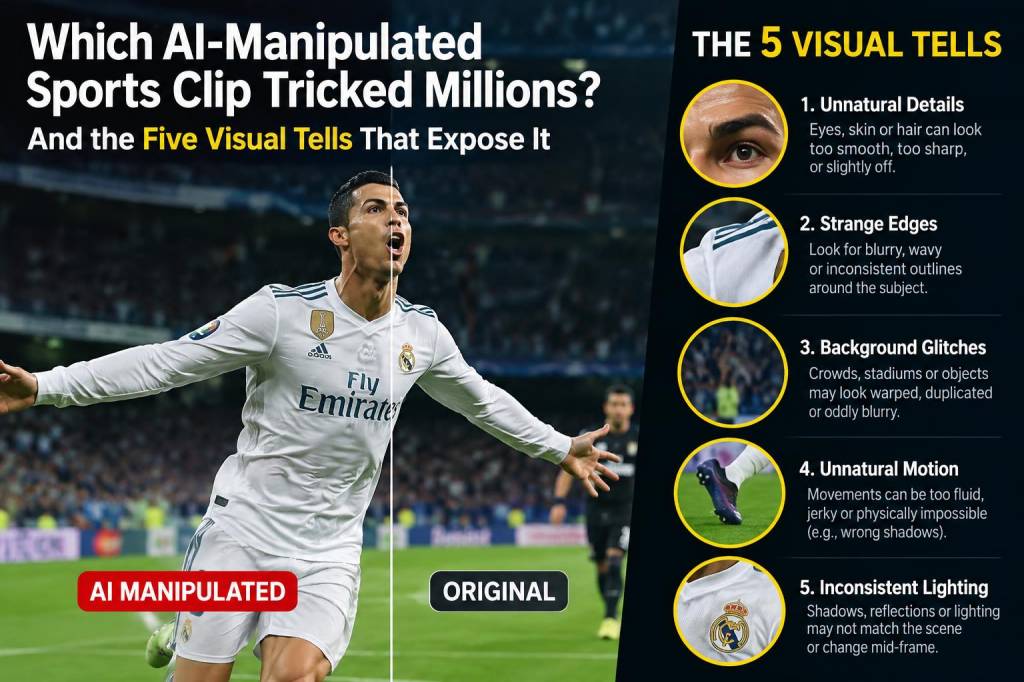
I remember the morning the clip started circling my feeds: a grainy, handheld-looking video of a stadium erupting as a player celebrates an impossible, game-winning play. By noon it had millions of views, pundits on podcasts were arguing about the call, and half my timeline was hyping the moment as “the play of the year.” I watched it three times, felt that gut thrill, then—something niggled. A few hours of digging later I realised the clip had been subtly manipulated with AI. It wasn’t just a viral moment; it was a lesson in how modern fakery preys on our instincts.
Which clip tricked millions?
For clarity: I’m not out to name-and-shame a single athlete or platform. What matters is the type of clip that fooled people—an apparently candid sideline video showing a decisive moment (a last-second goal, a controversial foul, a miraculous catch), posted on TikTok and reposted across X and Instagram Reels. It combined authentic audio snippets, real stadium shots, and digitally altered frames that changed the action just enough to create a false narrative.
These composites are typically produced using a mix of tools: frame interpolation to smooth edits, GANs (generative adversarial networks) or face‑swapping models to tweak players’ faces and expressions, and inpainting algorithms to alter objects or ball trajectories. Add a dash of social-engineering—fake accounts, strategic hashtags, a well-timed upload—and the result spreads faster than fact-checks can catch up.
The five visual tells that expose an AI-manipulated sports clip
If you want to stop reacting and start spotting, here are the five visual tells I’ve learned to look for. I keep this checklist handy whenever a “too-good-to-be-true” sports moment lands on my feed.
- Odd lighting and reflections
AI struggles with consistent lighting across composited elements. Watch for mismatched shadows, stadium lights that don’t reflect properly on helmets or glossy surfaces, or a player’s face lit from a direction that contradicts the background. Reflections in visors, puddles, or polished floors are surprisingly revealing—if they’re wrong, the whole scene can be fake. - Weird motion blur and frame timing
Real sports footage has messy micro-movements—clothing folds fluttering, sweat flying, breath vapor. AI-generated frames sometimes create unnatural motion blur: either too smooth (like a CGI rendering) or jittery in non-physiological ways. Likewise, pay attention to the timing of limbs or the ball; if the ball seems to "snap" between positions or a limb moves with an unusual easing, that’s a red flag. - Facial micro-expressions that don’t match the moment
Humans flash tiny expressions—micro‑smiles, flinches, squints—that AI often misses or misplaces. If a player’s face reads neutral right after a supposedly epic play, or their mouth movements don’t sync with the crowd noise and commentator audio, the face may have been swapped or generatively altered. - Background crowd and motion inconsistencies
Crowd footage is a nightmare to fake perfectly because of its chaotic variety. Look for repeating patterns (the same person or gesture duplicated), frozen pockets in the stands, or crowd reactions that lag the action. AI often composites foreground movement onto mismatched crowd plates, creating temporal dissonance. - Compression artifacts and inconsistent resolution
Many fakes hide in low-res or over-compressed uploads where mistakes are harder to see. But even in compressed clips you can spot inconsistent levels of noise: ultra-sharp faces against smudgy jerseys, or sudden resolution shifts mid-clip. Those are signs different sources were stitched together.
How I verify a suspicious clip (my routine)
When something rings false, I don’t rely on a single trick—I run a quick verification routine that takes under ten minutes.
- Reverse-image search key frames using Google Images or Bing to find the original footage.
- Check official feeds—team accounts, league channels, broadcasters (ESPN, Sky Sports, DAZN)—for a higher-quality source or denial.
- Look for multiple camera angles. Broadcast-level plays have at least two clean angles; a single shaky clip without corroboration is suspect.
- Examine metadata when possible. Tools like InVID can extract keyframes and help identify edits.
- Consult trustworthy fact-checkers (AFP, Reuters, Snopes) and the budding verification community on X and Reddit where people cross-check timestamps and broadcast logs.
Why these fakes spread so fast
There’s a perfect storm: social platforms reward engagement, and manipulated clips are engineered for it. Short-form formats (TikTok, Reels) prioritise immediacy and emotion—both exploited by creators seeking virality. AI tools like Runway, Synthesia, and FaceSwap lower the barrier to entry; now a determined creator can produce a plausible fake in hours, not weeks. Finally, confirmation bias does the rest: fans share what fits their narrative before checking it.
Practical tips for consuming sports clips
Here’s how I keep my feed honest without becoming paranoid:
- Favor primary sources. The first account to post a clip isn’t always the most credible; prefer official league or broadcaster uploads.
- Wait for replays. Real game-changing plays almost always show up in slow-motion replay or highlight packages—if you only see one shaky angle, be skeptical.
- Use verification tools. Install the InVID plugin, learn basic reverse-image search, and follow a few trusted sports-journalism accounts who call out fakes.
- Don’t be the amplifier. If you suspect a clip is manipulated, don’t share it without context. Commenting “unverified” can slow misinformation’s spread.
- Support media literacy. Share simple checklists (like the five tells above) with friends who fervently forward viral moments.
Final thought—why this matters for sports culture
Part of what makes live sports thrilling is the shared reality: everyone witnesses the same play and argues about it later. When AI starts rewriting those moments, it doesn’t just mislead—it corrodes the shared memory that sports fandom relies on. We need smarter tools and sharper eyes. Until platforms and leagues build better provenance systems, our best defense is a curious, slightly skeptical audience. That’s the role I try to play here at Crack Streams Co: call out the great moments worth savouring and the fakes that cheapen them.