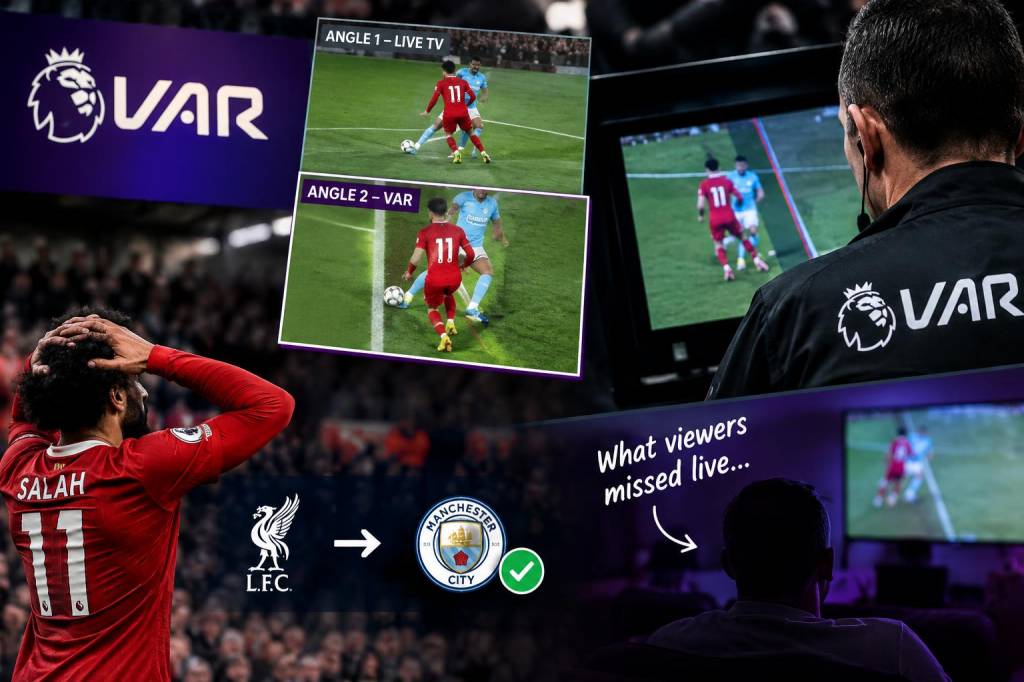
I still remember the moment the broadcast froze on a single frame and everyone in my living room leaned forward at once. It was not a stunning goal, not a reckless tackle, not even a classic penalty shout. It was a tiny VAR angle, the kind of image most viewers would barely register live, that quietly rewrote a Premier League result while most people were still reacting to what they thought they had seen on first watch. That is what made it so fascinating to me: not just that a decision changed, but that it changed because of a detail hidden in plain sight.
Football is often sold as a game of instinct, momentum, and raw emotion, and that is still true. But modern football also lives inside a second layer of reality, one built from freeze frames, camera angles, frame rates, and tiny positional shifts that can alter everything. I used to think most VAR debate came down to people disagreeing about interpretation. Sometimes it does. Yet moments like this remind me that viewers at home and officials in the booth are not even always looking at identical versions of the incident. A broadcast angle can flatten depth, a crowd reaction can convince us something obvious happened, and a replay can still miss the one viewpoint that matters most.
Why one angle can matter more than a dozen replays
What struck me first was how normal the incident looked in real time. On the live feed, I saw a fast move, bodies moving at different speeds, and an immediate reaction from players who clearly believed something had gone one way. If you were only watching live, you probably had the same experience: you formed a judgment in a second or two, then moved on because football does not pause for our comfort. That is part of what makes the sport addictive. It keeps going.
Then came the VAR review, and suddenly one camera angle made everything look different. Not because it was dramatic, but because it was precise. A foot placement, a shoulder line, a brush of contact, a slight offside position, or an earlier touch that changed the sequence entirely. These are the kinds of details that can be invisible from one angle and obvious from another. I think viewers often underestimate just how much perspective shapes judgment. In football, perspective is not a small thing. It is often everything.
From my point of view, that is the most frustrating and most interesting part of VAR at once. The system exists to reduce obvious errors, yet it can expose how much of our first reaction depends on incomplete information. A stadium crowd sees one thing. The main TV angle shows another. A reverse angle or tactical camera may tell a different story again. By the time the decision arrives, many fans have already attached themselves to a version of reality that might not survive review.
What viewers missed in real time
Most live viewers missed more than just the final verdict. They missed the chain of tiny clues that only became visible once the incident was slowed down and isolated. Live football is messy by design. Your eyes jump from the ball to the player who falls, then to the referee, then to the assistant, then to the crowd behind the goal. In that chaos, the real trigger can be easy to overlook.
In this case, what many viewers missed was not merely a possible infringement, but the timing of it. Timing is everything in VAR. A player may look level until the frame before the decisive touch. Contact may seem incidental until you see the attacker’s stride disrupted at the exact instant of impact. A handball may appear accidental until you notice the arm position relative to body shape and movement. Live, those details collapse into one blur. On review, they separate into a sequence.
I also think viewers missed the emotional whiplash that happens when a decision flips from instinct to evidence. One second, you are sure you have seen a goal, a foul, or a clean challenge. The next second, you are hearing that the outcome may change. That delay creates a weird gap between feeling and fact. Fans hate that gap because it interrupts celebration, but I have come to think it reveals something important about modern football: certainty is now provisional.
There is also a psychological trick at work. Once a replay begins, viewers tend to search for confirmation of what they already believe. If you think it is a foul, every angle feels like proof. If you think it is clean, every pause feels manipulated. The tiny angle that changed the result often matters because it is not shaped to confirm either side. It simply shows the incident from a vantage point that breaks the deadlock.
Why live television still struggles with football truth
I have spent enough time watching football on television to know that live coverage is fantastic at delivering emotion and not always fantastic at delivering context. Directors cut quickly between angles to keep pace with the action. Commentators react in real time, often before they can fully process what happened. Graphics arrive late. Replays are selective. That is not a criticism so much as a reality of broadcasting. A live match is an event, not a courtroom.
Still, moments like this expose the limits of live presentation. The audience is given a version of the action that is immediate but incomplete. When the decision changes after VAR, some viewers feel as if football is being taken away from them. I understand that reaction. I have felt it myself. Yet I also know that the live feed is often just the first draft of the truth, not the final one.
There is a strange irony here. Fans ask for accuracy, but accuracy often arrives wrapped in delay. They ask for transparency, but transparency requires extra angles, longer pauses, and more explanation. They want decisions that feel natural, but natural reactions are usually based on limited information. That tension is exactly why VAR keeps causing arguments. It is not only about whether the call was right. It is about whether people feel they were allowed to see football in the same way officials did.
How I read the reaction from players and fans
I always find player reactions revealing. Before the review, one group is already appealing, another is already celebrating, and a third is pretending not to care while still staring at the referee. That split second tells you how uncertain the moment really is. If everyone on the pitch had reacted the same way, the incident would have felt simpler. Instead, you often get a mix of hope, outrage, and confusion, which is usually a clue that something delicate happened.
Fans, meanwhile, become miniature broadcasters. We all become analysts when a decision hangs in the balance. One person says it is obvious, another says it is scandalous, a third starts quoting the Laws of the Game with alarming confidence. I like that part of football culture, even when it is chaotic. It shows how much people care. But it also reveals how quickly certainty can be built on a single angle that confirms a preferred story.
What I noticed after the decision was that the debate did not end with the official call. It moved to the replay language itself. People argued about whether the angle was enough, whether the frame rate misled them, whether the incident should have been judged differently without slowing it down. That is the modern football argument in a nutshell. The match is only the beginning. The real dispute starts when technology enters the room.
What a tiny angle says about the modern game
For me, the most interesting part of this whole episode is not even the result. It is what it reveals about football culture now. We live in a sport where margins are microscopic and consequences are huge. A boot a few centimeters ahead, a shirt pull lasting less than a second, a fingertip on a ball, a heel that slips half a step off line. These are tiny physical events, yet they can shape table positions, European qualification, relegation pressure, and every conversation that follows for days.
I think viewers miss how much the modern game depends on these tiny margins because the live experience still feels so emotional and fast. That emotional experience is real, but it no longer tells the full story. The broadcast gives us one rhythm. VAR gives us another. Between them lies the actual decision, hidden in a sliver of time and space.
That does not mean football has lost its drama. If anything, it has gained a new kind of drama, one that lives in suspended seconds. I do not love every consequence of that shift, but I cannot deny how compelling it is when a tiny angle changes an entire result. It makes me watch more carefully. It makes me question my first reaction. It reminds me that in football, as in life, what looks obvious at first glance is not always what survives closer inspection.
| Live view | Fast, emotional, incomplete |
| VAR view | Slower, narrower, more exact |
| Fan reaction | Instant, biased, passionate |
| Final decision | Based on a detail most viewers missed live |
What I will watch for next time
After watching a result swing on such a small visual detail, I now pay closer attention to a few things whenever VAR enters the picture. I watch which angle the broadcast chooses first, because that shapes the public reaction. I watch the players’ body language, because it often signals uncertainty before the replay does. I watch the referee’s patience, because a rushed explanation can make a correct decision feel wrong. And I watch my own reaction too, because I know how easy it is to build a strong opinion before the full picture arrives.
- I look for the first camera angle shown, because it shapes the emotional response.
- I notice whether the key contact happens before or after the main action.
- I pay attention to player reactions, since they often reveal hidden uncertainty.
- I wait for the reverse angle, because it can expose what the live feed missed.
- I separate instinct from evidence, even when the crowd around me does not.
That tiny VAR angle did more than alter one result. It exposed the gap between what football feels like in real time and what it actually is when reviewed from every side. And honestly, that gap is where much of today’s Premier League drama now lives.